The Crumbling Ecologies Project
Jasmine Targett
Thursday, May 17, 2012
A Closer Look at Weather Barometer
Weather Barometer, 2012.
Neon and Vinyl.
Jasmine Targett
The IUCN Red List of endangered species uses the chart depicted in Weather Barometer to categorise the rate of a species’ decline from Least Concern to Extinct. It can be suggested that by these classifications Craft is a Critically Endangered form of arts practice in Victoria. This is the highest risk category and indicates a species’ numbers will decrease by 80% within three generations.
The closure of craft based studios from Higher Educational Intuitions across Victoria will mean that the next generation of artists working in Melbourne will no longer have the resources to learn the technical skills necessary to practice craft professionally, dramatically altering the diverse landscape of Australian visual art.
Weather Barometer charts the current state of Craft as CR, perhaps ironically CR is also the abbreviation for Craft used by state and national funding bodies. The flickering light of EW explores the sense of urgency around the future of craft. Traditionally weather barometers have been used to alert the public to extreme weather conditions or in fundraising, to chart the level of funds raised. This conceptually links the instability of the current financial to the closure of Victoria’s Craft Studios.
CR – Critically Endangered
EW – Extinct in the Wild
The Skills Swap Meet
Workshop embraces the generous tradition of the Craft Community,
facilitating a free environment for sharing knowledge and skills while
getting to meet some amazing artistic people outside your circle.
Our first workshop was held from 10am - 3pm on Saturday 28th April in Craft Victoria's Library Space.....
The Facilitators
Sharon Clues
Skill - Machine Knitting

The Workshop - How to machine knit Sharon's custom design Crescent Scarf. (Pictured Left)
About - Sharon Clues is a Melbourne based textile artist with a passion for natural fibers & fabrics. she is the owner and creator of ethelruby –a luxury knit label & is currently studying textile design at RMIT.
http://www.etsy.com/shop/ethelruby
http://sclues.blogspot.com.au/
sclues@gmail.com
Emma Grace
Skill - Re-Fabricating Broken Costume Jewellery

Workshop - Participants are invited to fix or re-create broken or un-loved costume-jewellery and found objects into something new and unique.
Materials - All your old, broken and unloved costume/fashion jewellery and any other interesting bits and bobs you have lying about – you never know what might come in handy!
About - Emma Grace is a maker of contemporary jewllery and founder of The Treasury, a jewellery fixing and re-creation workshop aimed at promoting sustainability within the fashion industry. Her work is avaialble at Craft Victoria and e.g.etal and her next solo show will be held at e.g.etal in August 2012.
http://emmagracejewellery.wordpress.com/the-treasury/
www.emmagrace.com.au
enquiries@emmagrace.com.au
Sandra Eterovic
Skill - Fair Isle Knitting
The Work Shop - Participants will be given a copy of the paper graph for my 'Rags to Riches' scarf design. They will learn how to change colours within a row of knitting and how to follow a grid pattern.
Materials - 2 balls of contrasting yarn in the same gauge, preferably smoothly textured. Knitting needles to suit. A ruler and a pencil, for marking the pattern. I am assuming that participants will have basic knit/ purl knitting skills. It would be preferable for participants to have a couple of rows of knitting done before we start, but it's not necessary.
About Sandra - I am interested in the facades that our society encourages and the less comfortable things that lurk beneath. I enjoy exploring different materials, and am currently making painted wooden cut-outs, knitting, and considering exploring clay again.
sandraeterovic.blogspot.com
sandeterovic@gmail.com
We had a delightful day crafting, laughing and getting upto lots of making mischief!
Here is the bounty from our first Skills Swap Meet-


If your interested in being a workshop Facilitator or participating in another Skills Swap Meet - email jasminetargett (at) hotmail.com
Our first workshop was held from 10am - 3pm on Saturday 28th April in Craft Victoria's Library Space.....
The Facilitators
Sharon Clues
Skill - Machine Knitting

The Workshop - How to machine knit Sharon's custom design Crescent Scarf. (Pictured Left)
About - Sharon Clues is a Melbourne based textile artist with a passion for natural fibers & fabrics. she is the owner and creator of ethelruby –a luxury knit label & is currently studying textile design at RMIT.
http://www.etsy.com/shop/ethelruby
http://sclues.blogspot.com.au/
sclues@gmail.com
Emma Grace
Skill - Re-Fabricating Broken Costume Jewellery

Workshop - Participants are invited to fix or re-create broken or un-loved costume-jewellery and found objects into something new and unique.
Materials - All your old, broken and unloved costume/fashion jewellery and any other interesting bits and bobs you have lying about – you never know what might come in handy!
About - Emma Grace is a maker of contemporary jewllery and founder of The Treasury, a jewellery fixing and re-creation workshop aimed at promoting sustainability within the fashion industry. Her work is avaialble at Craft Victoria and e.g.etal and her next solo show will be held at e.g.etal in August 2012.
http://emmagracejewellery.wordpress.com/the-treasury/
www.emmagrace.com.au
enquiries@emmagrace.com.au
Sandra Eterovic
Skill - Fair Isle Knitting
The Work Shop - Participants will be given a copy of the paper graph for my 'Rags to Riches' scarf design. They will learn how to change colours within a row of knitting and how to follow a grid pattern.
Materials - 2 balls of contrasting yarn in the same gauge, preferably smoothly textured. Knitting needles to suit. A ruler and a pencil, for marking the pattern. I am assuming that participants will have basic knit/ purl knitting skills. It would be preferable for participants to have a couple of rows of knitting done before we start, but it's not necessary.
About Sandra - I am interested in the facades that our society encourages and the less comfortable things that lurk beneath. I enjoy exploring different materials, and am currently making painted wooden cut-outs, knitting, and considering exploring clay again.
sandraeterovic.blogspot.com
sandeterovic@gmail.com
We had a delightful day crafting, laughing and getting upto lots of making mischief!
Here is the bounty from our first Skills Swap Meet-

If your interested in being a workshop Facilitator or participating in another Skills Swap Meet - email jasminetargett (at) hotmail.com
Crumbling Ecologies Revealed....
Showing at Craft Victoria till Saturday June 9th.......
Crumbling Ecology, 2012.
Porcelain.
The last work to emerge from the now ‘devolved’ Monash Ceramic Studio, Crumbling Ecology is a large ephemeral installation made from over 35,000 hand made porcelain geraniums.
On the brink of crumbling, the porcelain geraniums embody the story of their makers- the artists, teachers and students directly impacted. Porcelain is a material known for its strength; using the material in this way comments on the loss of educators and the knowledge their hands pass on. Commenting on the beauty and integrity of craft that is soon to be lost, the ecology unable to regenerate, sits within a tenuous space. The outcome of the work and its value will be determined by the audience’s response...
Viewers are invited to take a leaf and pay what you think it is worth.
This work has been made by Jasmine Targett with the assistance of over 100 volunteering artists, crafters, students, teachers, curators and creative fellows in Victoria and New South Wales.
The Makers –
VIC
Jasmine Targett, Sally Cleary, Rebecca Mayo, Anthony Conway, Caroline Brandt, Jacinta Richardson, Stephanie Watson, Thomas Ryan, Atika Fraval, Janice Kent-Mackenzie, Rebecca Norris, Phoebe Norris, Shelley Grayden, Susannah Larritt, Cat Finnerty, Ian Wadley, Rebecca Delange, Adele Macer, Annette Martin, Julia Storey, Wen Shobbrook, Annie Quail, Elise Sheehan, Naomi Troski, Ri Van Veen, Lucy Hall, Sophie Harle, Ella Leoncio, Susan Frisch, Georgia Lancaster, Rosanna Cladwell , Kobie Nel, Ulla Britta Westergren, Kathryn de Jesus, Di Richardson, Jenna Wilson, Gabbie Hoff, Beka Hannah, Pauline Meade, Carmen Couche, Yanrong Wu, Simone Steel, Suse Scholem, Sinead Kennedy Tammy Warner, Annie Dowd, Miriam McGarry, Sari Harris, Sharyn Masson, Kristen Miller, Dee Strandly, Rachel Berry, Jacqueline Vermer, Cindy Leech, Declan Donald, Friederike Heinsdorff-Neill, Kim Davis, Sue Lawson and Laura Elphinstone.
NSW
Liane Rossler, James McCallum, Bridget Kennedy, Corrine Fisher, Hannah Fisher, Emilie Fisher, Jude Belnick, Maddy Ghosh, Ximena Tapia, Zeynep Bayraktar, Canbora Bayraktar, Rose Daridis, Brooke Thompson, Beau Thompson, Lucie Macany, Zoe Brand, Melanie Ihnen, Nina Still, Tilly
For more details on all of the works check out the new work's gallery -
http://www.crumblingecologies.blogspot.com.au/p/works-gallery.html
Crumbling Ecology, 2012.
Porcelain.
The last work to emerge from the now ‘devolved’ Monash Ceramic Studio, Crumbling Ecology is a large ephemeral installation made from over 35,000 hand made porcelain geraniums.
On the brink of crumbling, the porcelain geraniums embody the story of their makers- the artists, teachers and students directly impacted. Porcelain is a material known for its strength; using the material in this way comments on the loss of educators and the knowledge their hands pass on. Commenting on the beauty and integrity of craft that is soon to be lost, the ecology unable to regenerate, sits within a tenuous space. The outcome of the work and its value will be determined by the audience’s response...
Viewers are invited to take a leaf and pay what you think it is worth.
This work has been made by Jasmine Targett with the assistance of over 100 volunteering artists, crafters, students, teachers, curators and creative fellows in Victoria and New South Wales.
The Makers –
VIC
Jasmine Targett, Sally Cleary, Rebecca Mayo, Anthony Conway, Caroline Brandt, Jacinta Richardson, Stephanie Watson, Thomas Ryan, Atika Fraval, Janice Kent-Mackenzie, Rebecca Norris, Phoebe Norris, Shelley Grayden, Susannah Larritt, Cat Finnerty, Ian Wadley, Rebecca Delange, Adele Macer, Annette Martin, Julia Storey, Wen Shobbrook, Annie Quail, Elise Sheehan, Naomi Troski, Ri Van Veen, Lucy Hall, Sophie Harle, Ella Leoncio, Susan Frisch, Georgia Lancaster, Rosanna Cladwell , Kobie Nel, Ulla Britta Westergren, Kathryn de Jesus, Di Richardson, Jenna Wilson, Gabbie Hoff, Beka Hannah, Pauline Meade, Carmen Couche, Yanrong Wu, Simone Steel, Suse Scholem, Sinead Kennedy Tammy Warner, Annie Dowd, Miriam McGarry, Sari Harris, Sharyn Masson, Kristen Miller, Dee Strandly, Rachel Berry, Jacqueline Vermer, Cindy Leech, Declan Donald, Friederike Heinsdorff-Neill, Kim Davis, Sue Lawson and Laura Elphinstone.
NSW
Liane Rossler, James McCallum, Bridget Kennedy, Corrine Fisher, Hannah Fisher, Emilie Fisher, Jude Belnick, Maddy Ghosh, Ximena Tapia, Zeynep Bayraktar, Canbora Bayraktar, Rose Daridis, Brooke Thompson, Beau Thompson, Lucie Macany, Zoe Brand, Melanie Ihnen, Nina Still, Tilly
For more details on all of the works check out the new work's gallery -
http://www.crumblingecologies.blogspot.com.au/p/works-gallery.html
The Beauty of Weeds - New Images!
The Beauty of Weeds, 2012.
Regenerated plant waste, hand blown glass and salvaged furniture from ‘devolved’ studio space.
Jasmine Targett
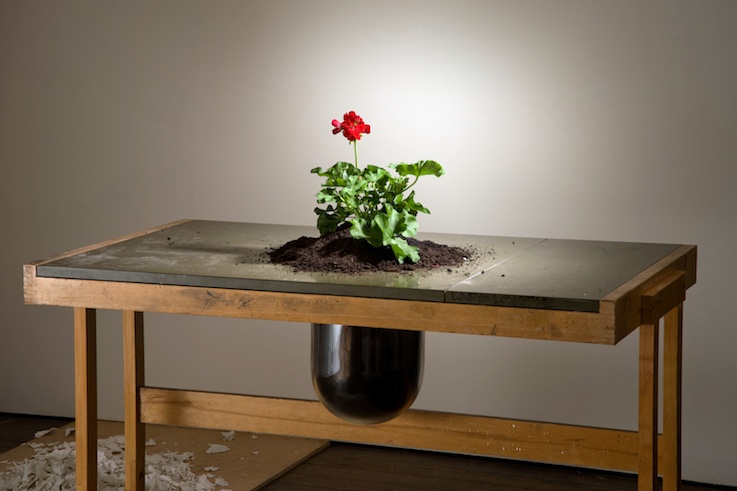
Cultivated from the unusable plant waste generated during the Crumbling Ecologies project, The Beauty of Weeds explores the indefinite boundaries between artwork and artefact.In the installation salvaged furniture from the ‘devolved’ Ceramic studio space has overnight become a relic of a craft no longer practiced. Somewhere between art school, gallery and museum, these relics echo the ambiguity facing the displaced Ceramic industry from future arts education.
Imbued with uncertainty of what lies ahead, traditional museum bell jars house regenerated plant waste cultivated from the casting process in the exhibition’s central work Crumbling Ecology. Within the installation the weeds and waste have become the medium, evolving the ‘art object’ beyond the hand of the artist, elevating craft to a conceptual form of contemporary arts practice.
The Beauty of Weeds is that “a weed is a plant that has mastered every survival skill” [1]... they just keep growing.
Wednesday, May 16, 2012
Lip Magazine Feature Article! Crumbling Ecologies: Craft, Community, Community
Lip Magazine's awesome reporter Emma Koehn has published a new article on the project - Crumbling Ecologies: Craft Community, Fragility.
Emma gives indepth insight into the project, the context in which was
made and the state of the arts industry today. We suggest you give it a read, its well worth it!!
Thanks for the shout out guys, its an honour to be in Lip !
Curator Grace Cochrane opens Crumbling Ecologies
Grace gave an amazing speech to open the exhibition. It meant a lot to me to have someone that I look up to so much from within the industry give insight into the works and commentary on my practice.
Speech Notes by Grace Cochrane
Crumbling Ecologies
Jasmine Targett, Craft, 26 April, 2012
Thank you Joe and Debbie from Craft Victoria for inviting me to speak about this exhibition. And congratulations to Jasmine Targett for the works she has made on the theme of ‘crumbling ecologies’.
Ecology – that’s a word we usually associate with the well-being of an environment, specifically a natural environment. We tend to think of ecologies as things that are precious, worth defending, and worth nurturing because we know that their well-being and continuation is to our benefit and, in a world worrying about the effects of climate change, worth nurturing to the benefit of the future of the planet.
But we also extend the meaning of ecology to the well-being of any kind of environment where the parts are mutually dependent, and exist to mutual benefit. So in talking about an arts ecology, we understand it to mean the infrastructure made up of makers, writers, dealers, galleries, museums, co-operatives, suppliers, funding bodies, related industries and education institutions. A healthy arts ecology needs them all.
It also needs a healthy economy, and what makes a healthy economy is a matter of debate. Is the link between ecology and economy always a good one? Or can there be elements of destruction as well as benefit, in favour of special interests – large or small?
And where does someone like Jasmine Targett, who started as a painter, and then moved towards working with glass in her honours year and is now completing her PhD, find her place in the art world talking about ecologies – in particular crumbling ecologies?
This isn’t the first work she has made along these lines. Last year she showed works on the theme of Life Support Systems, in an exhibition called Making Sense. Here, she used dichroic glass originally developed for NASA space suit helmets to examine what was described as alarming data about environmental issues to do with ozone layers, atmospheric conditions and greenhouse gases. These were then shown in Taipei in February. Professor John Gregory, in his essay Making Sense:from the Sublime to the Meticulous, discussed how these pieces presented ‘complex, disturbing data in lucid, evocative, even surprisingly beautiful form.’
But what have geraniums got to do with this? These ordinary, common pot-plants; this familiar, domestic tough and hardy perennial? It turns out, in terms of ecologies, that while in some places of the world particular geranium species are endangered, in others, including some parts of Australia, it runs rampant though indigenous plant habitats and is in the Alert List for Environmental Weeds! Is it plant or weed? Is it friend or foe? How do we place value on it? Is it old-fashioned and out of date in the garden popularity stakes? Or is it still keenly sought-after? What is its place in our environmental ecology?
Here, in Crumbling Ecology, the geranium is recreated as a mass on the floor, of beautiful porcelain shells cast from the originals, which have been sacrificed in the process of making. Do we walk around them, or trample on them? Do we covet them or destroy them? What does that say about us, either way?
At the same time, cuttings that weren’t used after the leaves were detached, appear here in Beauty of weeds, as new plants, propagated in Jasmine’s garden. The unusually bright red of the flowers is significant: this strain was developed by a local nursery and is noticeable in many gardens in her suburb. But however ‘new’ these plants might be, they are now planted in bell-jar containers whose usual purpose is to cover precious museum objects and relics. Blown by Jasmine, with colleagues Laurel, Tegan and Kirstin, these jars nurture something new, while being embedded in well-worn work benches which have been discarded from her university’s defunct ceramics studio. This whole project, in fact, was made on these benches.
And the wall-mounted Weather barometer – this is a real measure for the rate of decline for certain species according to a scientific scale from those of Least Concern, at one end, to Extinct, at the other. Where does the geranium feature here?
This is all very interesting and insightful. But it is not the only story here, of either ecology or economy. In fact, as you have no doubt realised already, the entire exhibition is a metaphor for the Crumbling Ecology of professional crafts education courses in Victoria – and indeed, in many other places. Particular reference has been made to the closure, or threat of closure, in many institutions, of full specialist courses in the crafts. At Monash University for example, ceramics and textiles have closed, while glass and jewellery (along with other art media areas) are offered within broad undergraduate BFA or BVA courses, with the opportunity of some specialisation there, as well as, in Jasmine’s case, in later postgraduate study.
There is such shared concern for the further decline in serious education of skill, knowledge and history of these fields of work, and its effect on the future, that Jasmine’s search for others to attend workshops and make geranium leaves to demonstrate their concern about this direction in education, met with an extraordinary response. Around 100 teachers, students and others who were enthusiastic about the opportunity to comment in this way, from Victoria and other states, have contributed to this installation over many months; many of them returning to make pieces and to talk about issues. Meanwhile, important parts of the ecology in the form of sponsors such as the City of Melbourne through an Arts Projects grant, Clayworks (through contributing porcelain clay) and Northcote Pottery (through contributing kiln-firing facilities) have supported the project and the exhibition.
Are the crafts endangered? Is the ecology of the crafts under threat? Is the education ecology diminished? What are the factors – economic, social and cultural – that contribute to a changing ecology in this field? Is it just to do with government funding systems of universities? Is it to do with the marketplace? Is it to do with our perceptions of vocational and personal aspirations, and the choices students make? And, moreover, how much can we influence the ecology in which all these issues exist, if we care about them?
Returning to the question of metaphor, and considering the educational questions in relation to each of these works, we could again ask of:
-Crumbling ecology: Do we trample on it and crush it, or carefully walk around it, or preserve important parts of it, as with these leaves?
-Weather barometer: The crafts are identified here as ‘critically endangered’. How do we measure the rate of change, and how do we place a value on it? What do we do then?
-Beauty of weeds: Can we grow something new in the crafts from the experiences of the past? How? Whatever will that be?
And will we still have the traditional skills to put together with new technologies to express ideas about a future, of crafts practice within art, design and industry, that might be based on the best of the past and present? In short, how do we maintain an exciting and sustainable crafts education ecology?
This work is provocative, topical and inspirational – congratulations to you Jasmine, and to all the people who have worked with you on this project.
I would like to thank Grace for her fantastic speech, I am so grateful that we have someone with her kind of wisdom and discernment to guide the industry into the future.
Speech Notes by Grace Cochrane
Crumbling Ecologies
Jasmine Targett, Craft, 26 April, 2012
Thank you Joe and Debbie from Craft Victoria for inviting me to speak about this exhibition. And congratulations to Jasmine Targett for the works she has made on the theme of ‘crumbling ecologies’.
Ecology – that’s a word we usually associate with the well-being of an environment, specifically a natural environment. We tend to think of ecologies as things that are precious, worth defending, and worth nurturing because we know that their well-being and continuation is to our benefit and, in a world worrying about the effects of climate change, worth nurturing to the benefit of the future of the planet.
But we also extend the meaning of ecology to the well-being of any kind of environment where the parts are mutually dependent, and exist to mutual benefit. So in talking about an arts ecology, we understand it to mean the infrastructure made up of makers, writers, dealers, galleries, museums, co-operatives, suppliers, funding bodies, related industries and education institutions. A healthy arts ecology needs them all.
It also needs a healthy economy, and what makes a healthy economy is a matter of debate. Is the link between ecology and economy always a good one? Or can there be elements of destruction as well as benefit, in favour of special interests – large or small?
And where does someone like Jasmine Targett, who started as a painter, and then moved towards working with glass in her honours year and is now completing her PhD, find her place in the art world talking about ecologies – in particular crumbling ecologies?
This isn’t the first work she has made along these lines. Last year she showed works on the theme of Life Support Systems, in an exhibition called Making Sense. Here, she used dichroic glass originally developed for NASA space suit helmets to examine what was described as alarming data about environmental issues to do with ozone layers, atmospheric conditions and greenhouse gases. These were then shown in Taipei in February. Professor John Gregory, in his essay Making Sense:from the Sublime to the Meticulous, discussed how these pieces presented ‘complex, disturbing data in lucid, evocative, even surprisingly beautiful form.’
But what have geraniums got to do with this? These ordinary, common pot-plants; this familiar, domestic tough and hardy perennial? It turns out, in terms of ecologies, that while in some places of the world particular geranium species are endangered, in others, including some parts of Australia, it runs rampant though indigenous plant habitats and is in the Alert List for Environmental Weeds! Is it plant or weed? Is it friend or foe? How do we place value on it? Is it old-fashioned and out of date in the garden popularity stakes? Or is it still keenly sought-after? What is its place in our environmental ecology?
Here, in Crumbling Ecology, the geranium is recreated as a mass on the floor, of beautiful porcelain shells cast from the originals, which have been sacrificed in the process of making. Do we walk around them, or trample on them? Do we covet them or destroy them? What does that say about us, either way?
At the same time, cuttings that weren’t used after the leaves were detached, appear here in Beauty of weeds, as new plants, propagated in Jasmine’s garden. The unusually bright red of the flowers is significant: this strain was developed by a local nursery and is noticeable in many gardens in her suburb. But however ‘new’ these plants might be, they are now planted in bell-jar containers whose usual purpose is to cover precious museum objects and relics. Blown by Jasmine, with colleagues Laurel, Tegan and Kirstin, these jars nurture something new, while being embedded in well-worn work benches which have been discarded from her university’s defunct ceramics studio. This whole project, in fact, was made on these benches.
And the wall-mounted Weather barometer – this is a real measure for the rate of decline for certain species according to a scientific scale from those of Least Concern, at one end, to Extinct, at the other. Where does the geranium feature here?
This is all very interesting and insightful. But it is not the only story here, of either ecology or economy. In fact, as you have no doubt realised already, the entire exhibition is a metaphor for the Crumbling Ecology of professional crafts education courses in Victoria – and indeed, in many other places. Particular reference has been made to the closure, or threat of closure, in many institutions, of full specialist courses in the crafts. At Monash University for example, ceramics and textiles have closed, while glass and jewellery (along with other art media areas) are offered within broad undergraduate BFA or BVA courses, with the opportunity of some specialisation there, as well as, in Jasmine’s case, in later postgraduate study.
There is such shared concern for the further decline in serious education of skill, knowledge and history of these fields of work, and its effect on the future, that Jasmine’s search for others to attend workshops and make geranium leaves to demonstrate their concern about this direction in education, met with an extraordinary response. Around 100 teachers, students and others who were enthusiastic about the opportunity to comment in this way, from Victoria and other states, have contributed to this installation over many months; many of them returning to make pieces and to talk about issues. Meanwhile, important parts of the ecology in the form of sponsors such as the City of Melbourne through an Arts Projects grant, Clayworks (through contributing porcelain clay) and Northcote Pottery (through contributing kiln-firing facilities) have supported the project and the exhibition.
Are the crafts endangered? Is the ecology of the crafts under threat? Is the education ecology diminished? What are the factors – economic, social and cultural – that contribute to a changing ecology in this field? Is it just to do with government funding systems of universities? Is it to do with the marketplace? Is it to do with our perceptions of vocational and personal aspirations, and the choices students make? And, moreover, how much can we influence the ecology in which all these issues exist, if we care about them?
Returning to the question of metaphor, and considering the educational questions in relation to each of these works, we could again ask of:
-Crumbling ecology: Do we trample on it and crush it, or carefully walk around it, or preserve important parts of it, as with these leaves?
-Weather barometer: The crafts are identified here as ‘critically endangered’. How do we measure the rate of change, and how do we place a value on it? What do we do then?
-Beauty of weeds: Can we grow something new in the crafts from the experiences of the past? How? Whatever will that be?
And will we still have the traditional skills to put together with new technologies to express ideas about a future, of crafts practice within art, design and industry, that might be based on the best of the past and present? In short, how do we maintain an exciting and sustainable crafts education ecology?
This work is provocative, topical and inspirational – congratulations to you Jasmine, and to all the people who have worked with you on this project.
I would like to thank Grace for her fantastic speech, I am so grateful that we have someone with her kind of wisdom and discernment to guide the industry into the future.
Reviewed! Crumbling Ecologies in The Age
Check out Dylan Rainforth's article on Crumbling Ecologies- A Dying Art?
The text reads -
A Dying Art? Across Australia's universities, specialist craft departments - glass, ceramics, tapestries, metals and jewellery - are being shut. The situation has become so bad that according to artist Jasmine Targett, when she applied for an arts grant for her current Craft Victoria exhibition Crimbling Ecologies (opening tomorrow night), Monash University - where she is doing her PHD - had a ceramics department; by the time she came to make the work, it did not. Targett worked with students, teachers and artists over a three-month period to create thousands of fragile porcelain geranium leaves (pictured) symbolising this fragile craft ecology. And Targett is going further to ensure specialist skills don't die out. This Saturday she has organised a Skills Swap Meet for sharing knowledge and skills. "The idea of the Skills Swap Meet is to get away from the institution, to learn from each other the old-fashioned way of passing down skills person to person," Targett says. craftvic.org.au
Subscribe to:
Posts (Atom)